Blog Post

Walkthrough Investor Tool
Daniel Malinovski
·
Co-Founder, Simplicity Group
·
We Built a Free Investor Matching Tool to Show You the VCs Already Funding Businesses Like Yours
Most fundraising target lists are built backwards. A founder downloads a directory of crypto funds, sorts it by assets under management, and starts sending, with no way of knowing which of those funds price rounds in their category, at their stage, at their size. The result is a pipeline full of names that were never going to lead, and a raise that stalls for months before anyone can say why.
The information that fixes this is public. Every announced round names its investors, and most name the lead; read enough announcements and you know precisely which funds have been pricing seed rounds in stablecoin infrastructure this year and which only ever follow. The problem is volume: there have been more than 1,300 disclosed digital asset raises since January 2025, and nobody holds them in their head. So we built a free tool that does. It lives at investor-match.simplicitygroup.xyz and it takes about two minutes.
In short: the Simplicity investor matching tool is a free, browser-based tool that benchmarks your raise against every disclosed digital asset funding round since January 2025 (currently 1,300+ rounds across 1,100+ projects and more than 2,000 named investors, refreshed weekly) and returns the comparable raises, the funds that led them, and the investors that followed on, each one supported by the specific deals that put it on your list.
What the investor matching tool is, and why we built it
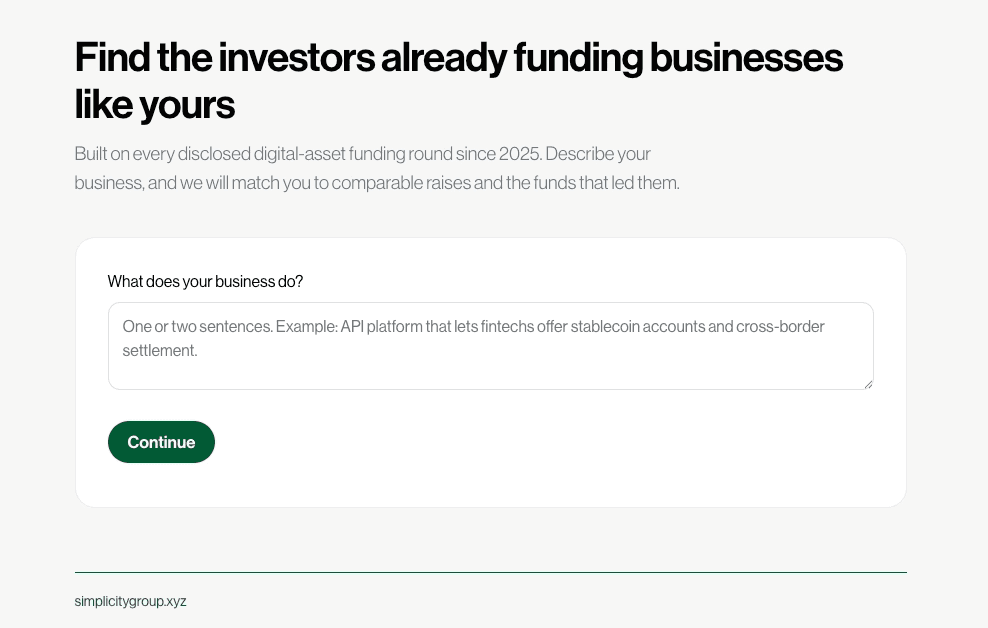
The tool is a deals-first investor database with a two-minute questionnaire on the front. Every disclosed digital asset raise since January 2025 sits in the dataset, and everything the tool knows about an investor is derived from those deals: how often a fund invests, how often it leads, the median size of the rounds it leads, which categories it concentrates in, and when it last moved. Nothing is hand-maintained, so a profile reflects what a fund has done since 2025 rather than what its website says it does.
That derivation matters more than it sounds. More than 2,000 investors appear in the dataset at least once, but only around 250 have done five or more deals since the start of 2025. A directory treats all 2,000 as targets; the deal history separates the funds deploying right now from the ones that wrote one cheque eighteen months ago and went quiet.
We built it because we already do this work manually. Investor research for a client raise means reading announcement after announcement to establish who genuinely prices rounds in a category, and it takes days per mandate. Most founders never get that research at all, and the cost shows up as three months of outreach to the wrong list. The tool compresses the first pass into two minutes and answers one question fast: who has been writing cheques into businesses like yours, recently, at roughly your size?
Describe the business, and the tool finds your category
The tool opens with a single free-text question: what does your business do? One or two sentences is enough. From the description it suggests a category from a controlled taxonomy of 23 narratives, deliberately broad labels such as Stablecoin Infrastructure, RWA & Tokenisation, or AI Agents, and you confirm the primary narrative plus up to two secondary ones.
The taxonomy is broad on purpose, because it mirrors how investors file deals. A fund does not run a thesis on "stablecoin payments for corridor remittances in the Gulf"; it runs a thesis on stablecoin infrastructure, and matching at that level is what lands you inside a fund's thesis rather than adjacent to it.
The rest of the questionnaire is your raise profile: the stage of this raise, the target amount, how much you have raised to date, whether there is a token component, your traction, and revenue if you have any. Stage and target do the most work, since they decide which slice of the deal history you are benchmarked against and how closely each fund's round-size behaviour fits yours.

Your raise, benchmarked before you commit to it
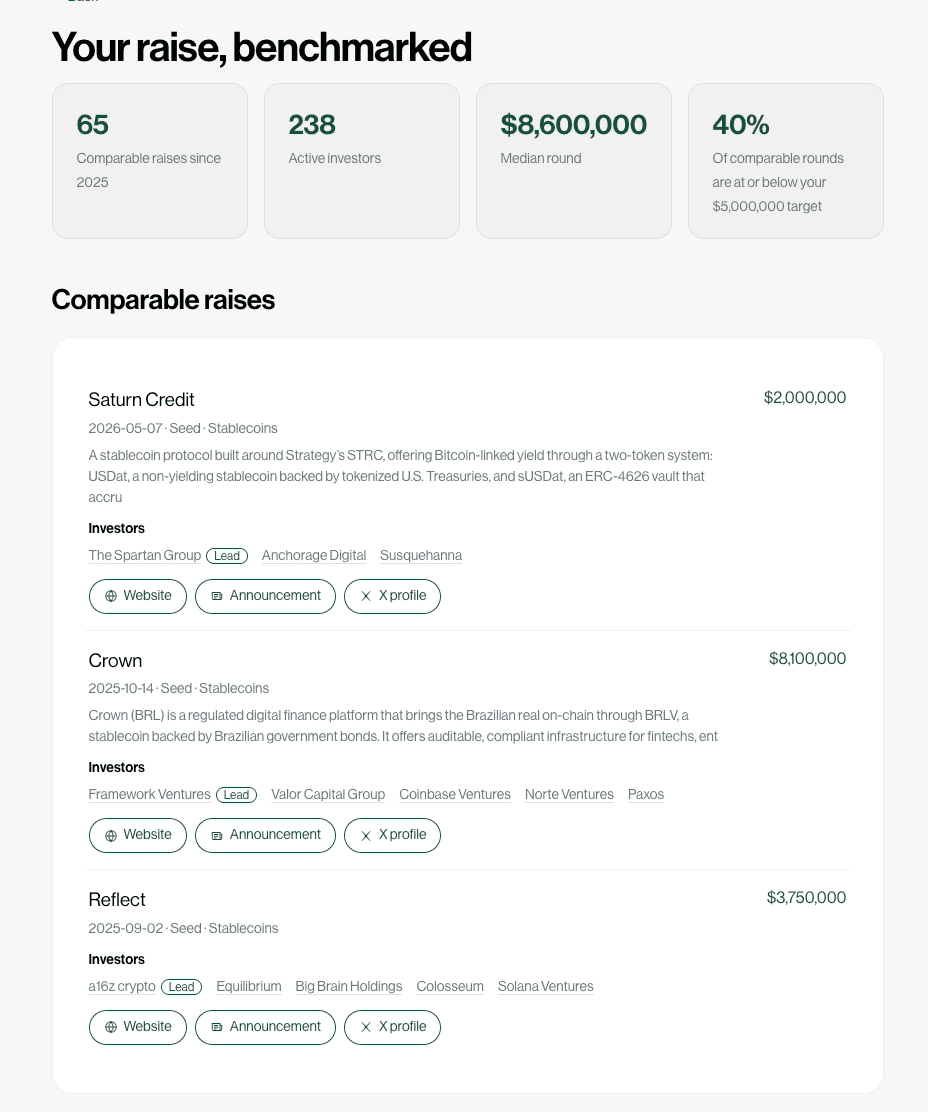
Before any email is asked for, the tool benchmarks your raise against its slice of the dataset: how many matching rounds have been announced since January 2025, how many investors were active in them, the median disclosed round size with the 25th and 75th percentiles, and the percentile your own target sits at.
That last number is the sanity check. A $20m target in a category where the median disclosed round is $4m puts you above the 90th percentile of comparable raises; the raise is not impossible, but it will be priced as an outlier, and outliers need evidence the median round does not. Founders tend to anchor targets on the headline rounds that made the news, whereas the percentile anchors them on everything the category has done, including the rounds nobody tweeted about.
The benchmark, three comparable raises, and your first lead target are free with no account. A work email unlocks the full report on screen; the email is the only thing we take, and the mailing list opt-in is a separate box, unticked by default.
What the full report gives you
The report has three sections, and every entry in each one carries the evidence for its inclusion.
Comparable raises. The twelve most relevant announced rounds, scored on category fit, stage, recency, and how close the round size is to your target. Each card shows what the project does, the round type, the amount, the valuation where disclosed, the date, and the full investor list with leads flagged, plus links to the project and the announcement. Comparables earn their place twice: they calibrate your ask against what the market has been paying, and they tell you which funds have already underwritten a thesis close to yours, along with which ones are likely conflicted out because they backed your nearest competitor.
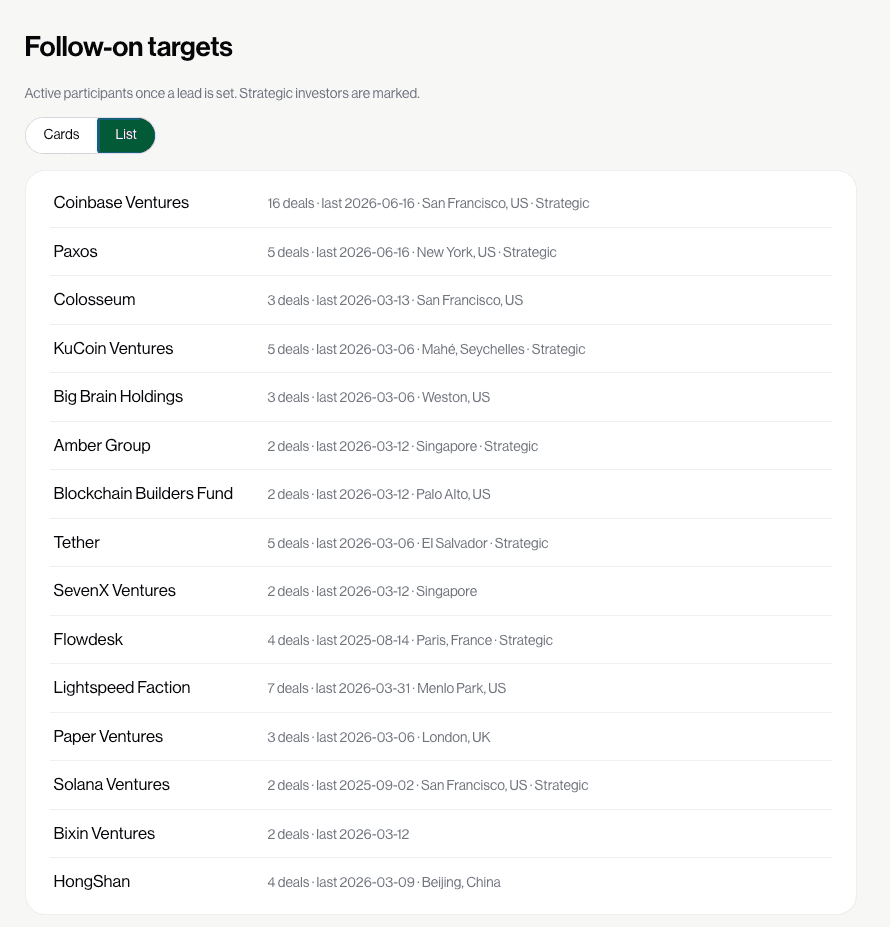
Lead targets. Twelve funds that have led rounds in your category since January 2025. This distinction is the point of the whole tool: a lead prices the round, writes the largest ticket, and gives everyone else something to join, whereas a follow-on joins terms someone else has set. A target list that does not separate the two is mostly names that cannot start your round. Ranking weighs how much lead activity a fund has in your slice, how recent it is, and how close your target is to the median round the fund leads.
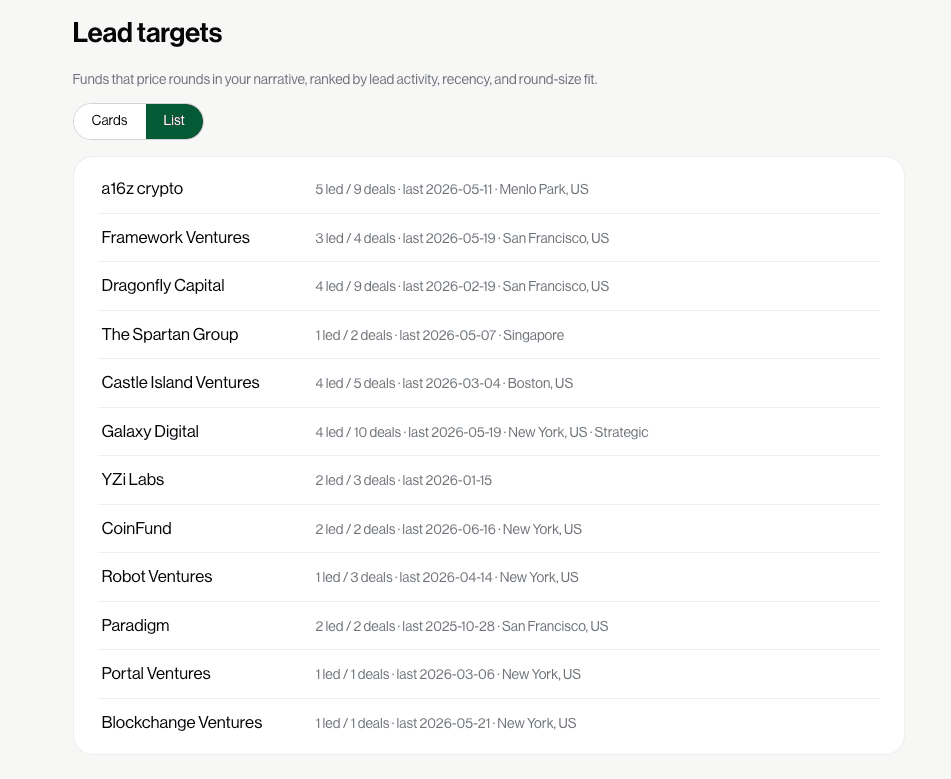
Follow-on targets. Fifteen investors that consistently participate in your category without leading, each with at least two relevant deals, and strategic investors badged so you can spot the ones whose cheque comes with distribution attached rather than capital alone. This is the list you work once a lead conversation is in motion and the round needs filling.
Every investor card shows its working: deals in your slice, rounds led, the date of the last relevant investment, the median round the fund leads, total deals since 2025, and the three most recent relevant deals by name. No investor appears on the list without the deals that justify it.
How the matching engine works
Every deal in your slice carries a weight rather than a binary match. Recency weighting means a round from last month counts more than one from January 2025, because funds go quiet, partners move, and category appetite rotates. Narrative weighting counts your primary category in full and secondary categories partially. Stage affinity scores a seed round higher against a seed-stage query than a Series B. Round-size fit runs on a log scale centred on your target, so if you are raising $8m, a $6m comparable reads as close and an $80m one as noise; round sizes behave multiplicatively, and the scale reflects that.
Lead ranking multiplies a fund's recency-weighted lead activity by its investor type (a venture fund that prices rounds outranks an angel or an exchange as a lead candidate) and by the fit between your target and the fund's median led round.
Three limitations are worth stating plainly, because they define what the output means. The dataset covers announced rounds only, and announcements lag closes by days to weeks, so a fund's most recent fortnight is always slightly out of date and stealth rounds never appear. Leads are counted only where an announcement discloses them. And there are no per-investor ticket sizes anywhere in public data: announcements report the round total and the investor list, not each fund's allocation, so the tool shows round-size behaviour (the median round a fund joins, the median it leads, the range) rather than inventing a number nobody publishes.
Where the tool stops and a real raise begins
The tool is deliberately narrow. It answers the targeting question, and it stops there. The list tells you who; the raise still has to be run.
Running it means positioning and materials an investor can underwrite, a data room that survives diligence, sequencing so that follow-ons are soft-circled while lead conversations progress and term sheets land close together, warm paths into funds instead of cold inbound, and negotiation once interest turns into terms. It also means context the deal history cannot hold: the dataset can tell you a fund led three stablecoin infrastructure seeds since 2025, but it cannot tell you that the third one took the last cheque of the fund, or that the partner who championed the category left in the spring.
That is the work we do in fundraising support engagements, inside our distribution and go-to-market advisory: refining the machine-built list against fund cycles and conflicts, building the materials, sequencing the process, and making the introductions where we hold the relationship. The tool is the first pass of that engagement, free, for anyone.
If you want the full picture
Simplicity Group has worked with 200+ projects, contributed to over $2.5bn in market cap, and helped teams raise more than $160m. Both co-founders hold MSc Economics degrees from the University of Leeds, and we mentor at the Solana Foundation, Techstars Web3, Cointelegraph Accelerator and Outlier Ventures. Fundraising support runs through our distribution advisory at simplicitygroup.xyz/digital-asset-distribution, and if your raise has a token component, the same product suite includes our free tokenomics tool at tokenomics.simplicitygroup.xyz, which we wrote up separately.
So run the tool. If the benchmark puts your target in the 95th percentile of your category, or the lead list comes back shorter than your deck assumes, that is information worth having before the process starts rather than after it stalls. The tool is at investor-match.simplicitygroup.xyz, and the rest of what we do is at simplicitygroup.xyz.
Better to spend two minutes learning who funds businesses like yours than three months learning who does not.
Frequently asked questions
What is the Simplicity investor matching tool?
A free, browser-based tool at investor-match.simplicitygroup.xyz. You describe your business, confirm your category, stage, and target raise, and it benchmarks the raise against every disclosed digital asset funding round since January 2025, then returns comparable raises, lead targets, and follow-on targets, each supported by named deals.
Is the investor matching tool free?
Yes. The benchmark, three comparable raises, and your first lead target are open with no account. Entering a work email unlocks the full report: twelve comparables, twelve lead targets, and fifteen follow-on targets. Fundraising support from our team is a separate paid engagement.
Where does the investor data come from?
Publicly announced funding rounds, aggregated and enriched by us. The dataset covers every disclosed digital asset raise since January 2025, currently more than 2,500 rounds across 1,100+ projects and over 2,000 named investors, and it refreshes weekly. Investor profiles are derived entirely from those deals; nothing is hand-maintained.
Is my information private?
The questionnaire and the benchmark need no account. The full report asks for a work email so we can follow up, and that is the only thing we take; the mailing list opt-in is a separate checkbox, unticked by default. Your business description is used to match you to a category and is not published anywhere.
What is the difference between lead targets and follow-on targets?
A lead prices the round: it sets terms, writes the largest ticket, and gives other investors something to join, whereas a follow-on joins terms someone else has set. Lead targets are funds that have led at least one round in your category since January 2025, ranked by lead activity, recency, and round-size fit. Follow-on targets are investors with two or more relevant participations in your category, with strategic investors flagged.
Will it tell me how much each investor writes per deal?
No, because that number is not public. Announcements disclose the round total and the investor list, not per-investor allocations, so the tool reports each fund's round-size behaviour instead: the median round it joins, the median round it leads, and the range. That is enough to judge whether your raise is in a fund's range without inventing precision the data does not have.
How is this different from working with Simplicity on a raise?
The tool answers the targeting question from disclosed data. A fundraising support engagement covers everything the data cannot: positioning and materials, the list refined against live fund cycles and conflicts, sequencing, introductions where we hold the relationship, and support through terms. Use the tool first; if the output raises questions about how to run the process, that is the conversation to have with us.

Co-Founder of Simplicity Group. BA Economics and Philosophy, continued to Masters. Advises digital asset and AI businesses on distribution and fundraise strategy; speaker at 25+ conferences across 10+ countries.
Category
Company Updates
Read Time
Company Updates
Brief
A free tool that shows which VCs have actually led rounds in your category
Copy Link
Copied!
Share with founders, operators, and teams building in crypto.
Put this into practice
If this article raised questions about your own token or go-to-market plan, our team can help you work through them.