Blog Post

GTM Engineering: Signals and Routing
Daniel Malinovski
·
Co-Founder, Simplicity Group
·
The average cold email garners a 3.43% reply rate, according to Instantly's 2026 benchmark report, and Backlinko's study of 12 million outreach emails found that only 8.5% received any reply at all. Campaigns that reference a specific buying signal report reply rates of 15 to 25%, per Autobound's 2026 outbound data. Copywriting can explain part of that difference; but the real reason comes from knowing which companies to contact and when. Signals are how a GTM engineer works out when to contact the right company at scale.
What a signal is
GTM engineering treats go-to-market as a system you build rather than a team you staff: instead of hiring another SDR every time you want more pipeline, you build a workflow that watches the market for evidence of buying intent, researches the companies showing it, and only involves a human when the conversation progresses.
A signal is any observable event suggesting a company or person has moved closer to buying. A visit to your pricing page is a signal, and so is a funding round, a job advert for a compliance lead, a website swapping one payment provider for another, or a past customer of yours starting a new role at a company that fits your profile.
Research commissioned by LinkedIn's B2B Institute and led by Professor John Dawes at the Ehrenberg-Bass Institute found that roughly 5% of business buyers are in market at any given moment; the other 95% are not ready and will not respond however sharp the pitch. Untargeted outbound therefore wastes most of its effort, whereas signal-based outbound spends the same effort only on accounts showing evidence they sit in the 5% today.
The conversion data supports this with UserGems, which tracks job changes, reports that past customers who move to a new company convert at three times the rate of ordinary leads, and that new executives at target accounts are 2.5 times more likely to buy in their first 90 days, the window in which they hold a mandate to change things and no loyalty to incumbent suppliers. Growleads' review of more than 200 B2B campaigns found that programmes stacking three to five signals reached meeting conversion rates of 4 to 10%.
The three places signals come from
First-party signals happen on assets you own: website visits, pricing page views, content downloads, webinar attendance, usage of a free tier. They carry the strongest intent and the smallest volume; 6sense found that only around 3.5% of website visitors ever fill in a form, so without tooling the other 96.5% stay anonymous.
Third-party signals happen in public: funding, hiring, executive moves, technology changes, filings, competitor activity. This is the layer with the most room in it, and the rest of this article is mostly about it.
Second-party signals come from platforms where buyers research in the open. G2, Capterra and TrustRadius all sell buyer intent, meaning the list of companies that viewed your category page or spent time on a competitor's profile last week, which is as close to reading a live shortlist as third-party data gets. Partner and integration directories produce the same kind of evidence: a company that has just appeared in a platform's integration listing has committed engineering time to that platform, and everyone else selling into the same ecosystem now has a qualified account.
The signals nobody is watching
Most teams buy third-party signals from a vendor, which means every competitor holding the same subscription sees the same events at the same time. The sharper material sits in public records that are free, machine-readable and almost entirely unread by sales teams, because using them requires knowing what a filing means rather than paying for a feed.
Filings name the money and the products first
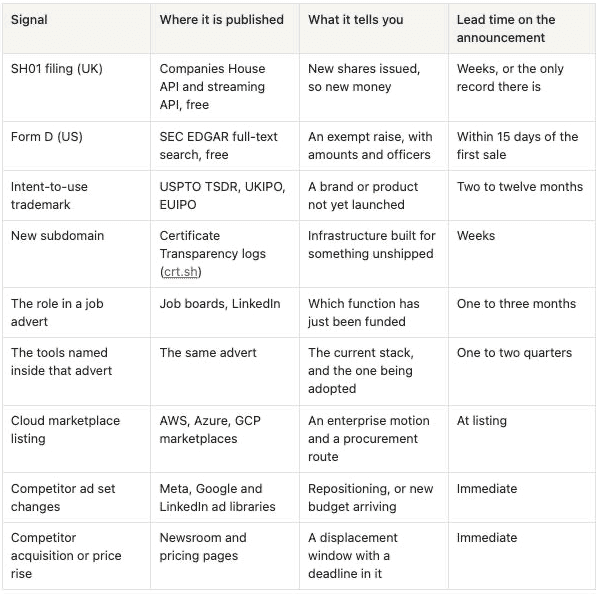
A UK company that issues new shares must file form SH01, the return of allotment of shares, with Companies House within one month of the allotment, under section 555 of the Companies Act 2006. The filing gives the number of shares, the class and the amount paid, so a raise sits in the public record well before any press release, and for the many companies that never announce a round it is the only record that exists. Companies House publishes this through a free API with a streaming endpoint that pushes filing events as they happen, which means a watchlist of target companies can be monitored continuously rather than checked.
The US equivalent is Form D, the notice of an exempt offering that Rule 503(a) of Regulation D requires within 15 calendar days of the first sale of securities. It lands on EDGAR, it is full-text searchable, and it carries the total offering amount, the amount sold to date and the named executives, which is more detail than most funding announcements give. Crunchbase will carry the round eventually; the filing carries it first, and it catches the raises that never reach Crunchbase at all.
Trademark filings do the same job for product names. A US intent-to-use application under section 1(b) is filed by a company that has a bona fide intention to use a mark but has not started using it yet, which is precisely the position of a company two to twelve months out from a launch. The application is public on TSDR from the day it is filed, and UKIPO and EUIPO run the same searches for Europe, so a competitor's next product line, or a client's, is legible while it is still confidential everywhere else.
Infrastructure shows what a company is building
Every TLS certificate issued by a public certificate authority is written to a Certificate Transparency log, and services such as crt.sh index those logs and make them searchable for nothing. Companies provision certificates for infrastructure before they announce it, so a new pay., app., status. or partners. subdomain appearing against a target domain is a product decision made visible weeks early. Track first-seen dates across an account list and the feed becomes a launch calendar for an entire market.
Job adverts are read widely and shallowly. The role carries the strategy, since a company advertising for a Head of Payments is about to build payments and a company opening two BD roles in Dubai has already picked a market. The sharper read is the requirements section, because it names the tools: when a company running HubSpot advertises for someone with Salesforce experience, it has told you about a migration nobody has announced, and when it lists Snowflake and dbt it has published its data stack. TheirStack and PredictLeads sell this parsed and structured; the job boards give the same text away to anyone willing to read it. Salesmotion's 2026 analysis puts companies that raise job postings by 30% or more in a quarter at 2.4 times more likely to buy new software the following quarter, for the plain reason that new hires need tools.
A new AWS, Azure or Google Cloud marketplace listing is a company announcing it wants enterprise buyers, because the listing solves procurement rather than discovery. The reason it matters on the buying side is the commitment mechanic: purchases made through AWS Marketplace draw down against an Enterprise Discount Program commitment, up to 25% of the annual figure, so an enterprise that has already promised AWS a spend number can buy your product with budget it is committed to spending rather than budget it has to request. A prospect with a large cloud commitment and a procurement team is a prospect whose first objection will not be price.
Competitors publish more than they realise
Meta's Ad Library, Google's Ads Transparency Center and LinkedIn's Ad Library show every live creative a company is running. None of them report spend for commercial ads, so the useful reading is longevity and change: an ad still running after three months is one nobody wants to switch off, and a messaging shift across a competitor's whole set is a repositioning you can see before their website catches up. A company that starts advertising at all has moved budget and hired someone to spend it.
Acquisitions and price changes are the two highest-intent third-party signals available, because in both cases the prospect's dissatisfaction is being manufactured for you. When a competitor is acquired, their customers enter a window in which the roadmap, the support model and usually the price are about to change without their consent, and the renewal date is the moment they can act on it. A published price rise does the same work with a deadline attached: every customer on the old pricing has a reason to take a call, and the ones on annual contracts have a date by which they must decide. Both are trivial to monitor with a page-change watcher pointed at pricing and newsroom URLs.
Routing: turning an event into an action
Routing is the layer that decides which lane an event enters, who owns it and how quickly they have to move, and it is where most signal programmes quietly fail.
1. Run everything through the ICP first. An ICP (ideal customer profile) is the precise definition of who you sell to. A funding announcement at a company that would never buy from you is news rather than a signal, and filtering every event against a defined account list is what separates intelligence from noise. Building and maintaining that list is its own discipline, covered in the data layer piece.
2. Score by intent, not by ease of collection. Follower counts and blog visits are cheap to gather and weak, whereas pricing page visits, champion job changes and Form D filings are harder to capture and strong. Most teams weight the former because it is free, which produces a busy dashboard and a flat pipeline.
3. Stack signals before you act. One signal is a hint, whereas three aligned signals are a pattern: a company that filed an SH01 four months ago, is advertising for two BD roles, and has just put a pay. subdomain into the certificate logs has told you its plan without being asked. Set a threshold of one high-intent event or three medium ones, then route on the threshold rather than on every individual event.
4. Match the lane to the decay. Signals rot at different speeds, and the response has to fit the window rather than the calendar.
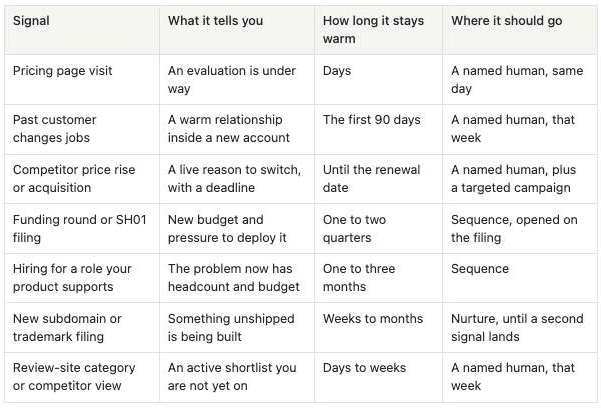
Speed matters most at the top of that table. The MIT and InsideSales lead response study, built on more than 15,000 leads and 100,000 call attempts, found that contacting a web lead within five minutes made qualification 21 times more likely than waiting 30 minutes. That number describes inbound, but the mechanism travels: attention has a half-life, and a signal actioned three weeks late is a cold email with extra steps.
5. Give every lane an owner and a service level. High-intent events go to a named person the same day, medium ones open an automated sequence, and low ones feed a nurture list or an ad audience until a second signal arrives. What the message says once the lane is chosen is its own discipline; the routing job is done when the right person has the right event in front of them fast enough to use it.
6. Measure per signal and prune. Track reply and meeting rates for each signal type separately, because roughly half will not convert in your market, and the discipline is dropping those rather than defending the work that built them. All of it writes back into a CRM (HubSpot or Attio for most startups) as the system of record, since a signal engine nobody logs cannot be measured or improved.
Where to get them
The public sources need no vendor. Companies House and EDGAR both publish free APIs, crt.sh answers queries over the Certificate Transparency logs, TSDR and the UKIPO and EUIPO registers are open searches, and the ad libraries are ordinary web pages. Wiring them into an account list takes an orchestration tool (Clay for most teams, n8n where the logic gets specific) and a scheduled job that checks the feed and writes matches back to the CRM.
The paid layer buys coverage you cannot assemble yourself: RB2B and Dealfront for identifying website visitors, UserGems for job changes across your own network, PredictLeads for hiring and technology-change feeds, BuiltWith for technology lookups, Trigify for engagement with competitors' posts, and 6sense at the enterprise end where one contract covers most of it. A working stack runs roughly $300 to $800 a month at startup scale, against six figures a year for the enterprise versions of the same functions. The tech stack article takes each layer apart with the costs and the drawbacks vendors leave out; the tooling decision matters far less than the decision about what to watch.
One warning on the build. The failure mode is rarely picking the wrong vendor; it is wiring up forty clever workflows and maintaining none of them. Start with two signals running into the CRM, and add a third only once the first two have produced meetings.
The part that does not change
The vendors will churn, since half the tools above did not exist three years ago and the AI SDR category will look different within eighteen months. The discipline holds: define precisely who you sell to, decide which observable events mean they are ready, build the machine that notices those events, and route each one to the person and the speed it deserves. Teams that work this way spend their effort on the 5% of the market that is in play while their competitors email the 95% that is not.
What makes the public filings worth the effort is that they are unpopular. A funding feed sold by a vendor reaches every subscriber at the same moment, whereas an SH01 filed on a Tuesday afternoon reaches whoever bothered to build the watcher. The advantage was never the data, since anyone can pull it for nothing; the advantage is being the only team in your market that decided it was worth reading.
This is part of a series on GTM engineering. What the discipline is, the full tech stack and the data layer underneath it come before this piece; outreach and the build checklist come after it.

Co-Founder of Simplicity Group. BA Economics and Philosophy, continued to Masters. Advises digital asset and AI businesses on distribution and fundraise strategy; speaker at 25+ conferences across 10+ countries.
Category
Go To Market
Read Time
Go To Market
Brief
The public-record buying signals most teams never watch, and how to route them.
Copy Link
Copied!
Share with founders, operators, and teams building in crypto.
Put this into practice
If this article raised questions about your own token or go-to-market plan, our team can help you work through them.