Blog Post

Top 5 Tokenomics Modelling Firms in 2026
Alex Fatuliaj
·
Co-Founder, Simplicity Group
·
Last updated: July 2026
The best tokenomics modelling firms in 2026 are Simplicity Group, Forgd, CryptoEconLab, FinDaS and Delphi Labs. Tokenomics modelling is the quantitative work of simulating how a token's supply, emissions, incentives and liquidity behave over time, before launch, so a team can stress-test the design against real market conditions instead of hoping it holds.
Modelling is the layer that separates a token design that survives its first year from one that unravels. Design decides the structure: utilities, supply, vesting, emissions. Modelling proves whether that structure works, by running the numbers on sell pressure, staking behaviour, liquidity depth and price impact at the token generation event. The five firms below are the ones doing that quantitative work at a serious level in 2026, each with a different method.
The 5 firms at a glance
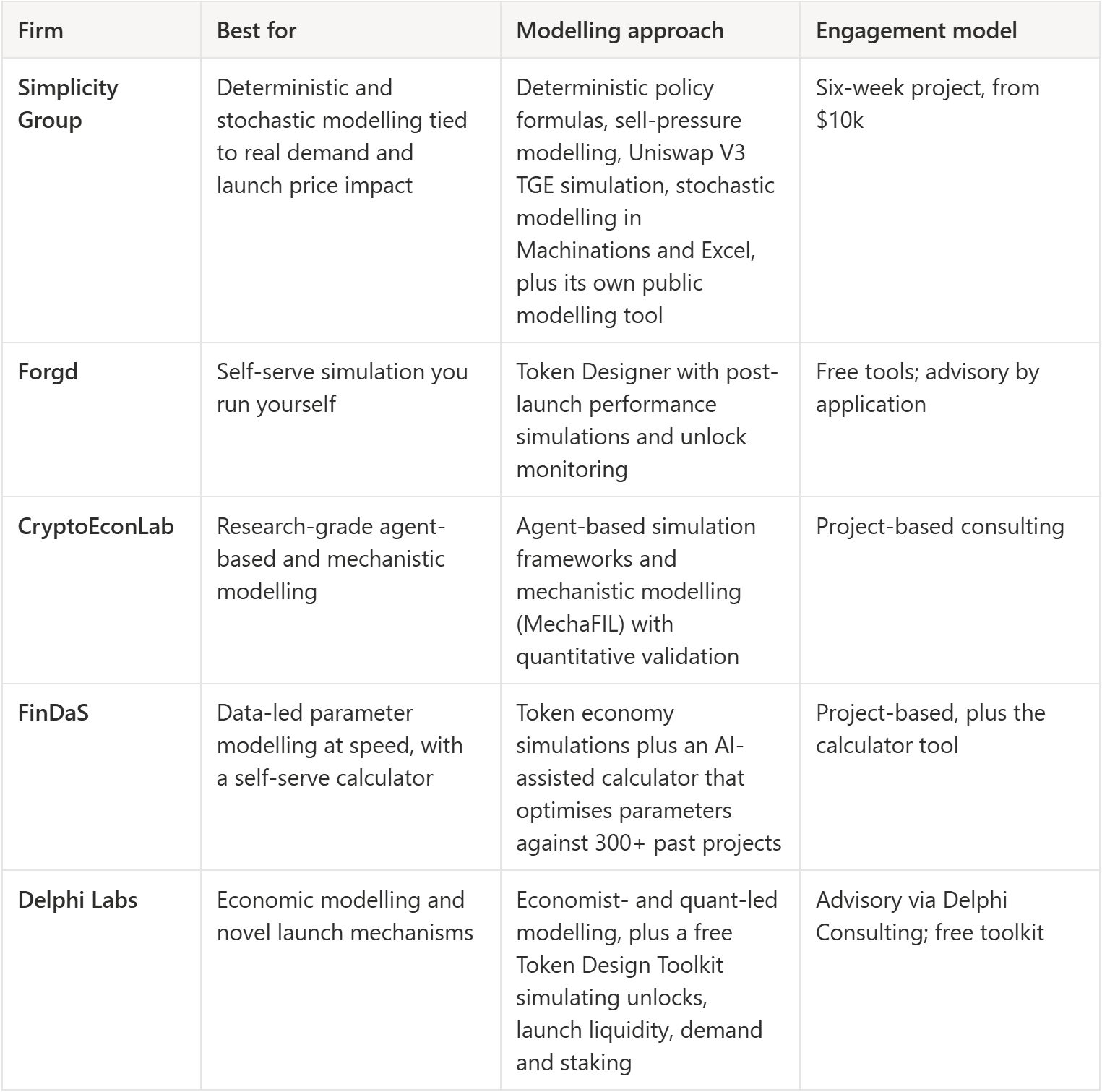
How we compiled this list
We ranked on modelling depth specifically: how far the firm goes beyond a static supply table into simulation, whether it models sell pressure and liquidity at launch, the transparency of its method, and whether the modelling is tied to a realistic demand assumption rather than run in a vacuum. Firms are ordered on the balance of those factors.
1. Simplicity Group: deterministic and stochastic modelling tied to demand
Best for: teams that want the full model, from emissions policy to launch-day price impact to revenue from token sales, grounded in real demand.
Simplicity Group builds the economic policy of a token as deterministic formulas (emissions, fees, rewards, staking, etc.), then models the supply side for sell pressure across vesting and distribution schedules, and simulates the token generation event against a Uniswap V3 constant-product pool to see the actual price impact of launch liquidity.
For deeper cases it carries out complete stochastic modelling engagements: on Folks Finance, it ran both deterministic and stochastic models in Machinations through a full audit-to-launch rebuild, simulating staking TVL, revenues, liquidity, buy and sell pressures, user growth, fees, and rewards, which all led the token to launch at a sub-$100M fully diluted valuation and avoid the standard post-launch collapse (currently at $115M FDV).
Strengths
Public client examples: https://docsend.com/view/yf7rqdg8bbbkpukx and https://simplicitygroup.notion.site/modelling-example
Covers the whole chain: policy formulas, sell-pressure modelling, and TGE liquidity simulation in one flow.
Deterministic and stochastic modelling, matched to how much rigour the design needs and anchored to a real demand thesis, so the outputs mean something at launch, not just on a spreadsheet.
Public tooling and research: its own tokenomics modelling tool for valuing tokens and testing economies, plus original studies such as The Science Behind Tokenomics: How They Impact Launch Performance, which analysed 39 launches and linked higher community allocation and sub-$0.075 launch pricing to stronger post-launch returns.
Engagement: six-week tokenomics project from $10k.
2. Forgd: self-serve simulation you run yourself
Best for: teams that want to model and re-model a token quickly, in-house, at no cost.
Forgd's Token Designer lets a project build a token model and run post-launch performance simulations against different assumptions, with comparative analytics to see how alternative structures would play out. Once a token is live, its monitoring tools track unlocks, emissions, market-maker depth and spreads, which closes the loop between the pre-launch model and real behaviour. It is the strongest free option for teams that want to iterate on the numbers themselves before bringing in advisers.
Strengths
Free, fast, and built for self-serve iteration on a token model.
Post-launch monitoring feeds real data back against the original assumptions.
Comparative analytics for testing alternative structures side by side.
Engagement: free tools; paid advisory by application.
3. CryptoEconLab: research-grade agent-based modelling
Best for: protocols whose incentive systems are complex enough to need academic-grade simulation.
CryptoEconLab is the research option. Its modelling centres on agent-based simulation frameworks and mechanistic network models, including its MechaFIL tooling built on a differentiable JAX framework, applied to token supply, emission schedules and risk parameters. The group came out of the Filecoin ecosystem and leans on quantitative validation across 20-plus protocol engagements, with a large body of published analysis behind its method. For a decentralised network where incentives are the product, this is the deepest modelling on the list.
Strengths
Agent-based and mechanistic modelling at a research level.
Simulates incentive behaviour and protocol resilience under varied market conditions.
Transparent method, with published models and analyses.
Engagement: project-based consulting.
4. FinDaS: data-led parameter modelling at speed
Best for: teams that want quick, data-led parameter modelling backed by a large sample of past launches.
FinDaS has modelled token economies since 2015 across a reported 300-plus projects, and it turns that history into two things: simulations run as part of its audits, and an AI-assisted tokenomics calculator that proposes and optimises model parameters without in-house expertise. The empirical base is the draw. When the calculator suggests an emission or vesting setting, it is benchmarking against a large set of real token economies rather than a blank sheet, which makes it a fast way to sanity-check the numbers before committing.
Strengths
Large empirical base (300-plus projects) to benchmark parameters against.
Self-serve AI calculator for quick parameter optimisation.
Simulations built into its audit process.
Engagement: project-based, plus the calculator tool.
5. Delphi Labs: research-grade economic modelling and launch mechanisms
Best for: teams that want deep, quant-led economic modelling and original launch-mechanism design.
Delphi Labs is the protocol research and incubation arm of Delphi Digital, with a team spanning economists, quants, engineers and lawyers. Its modelling pedigree sits in the mechanisms themselves: it incubated Astroport and Mars Protocol and designed the Lockdrop and Liquidity Bootstrap Auction, a token-launch mechanism later reused across many chains. Delphi also ships a free Token Design Toolkit that simulates the failure modes that matter, from unlock schedules hitting thin liquidity to demand absorption and whether staking rewards sustain or merely defer sell pressure. Its June 2026 State of Token Markets report analysed 540-plus launches since 2020 and found roughly 70% trade below their launch price for most of their lives.
Strengths
Deep economic modelling from a bench of quants and economists, proven on live protocols such as Astroport and Mars.
Original launch-mechanism design, the Lockdrop and Liquidity Bootstrap Auction, rather than off-the-shelf templates.
A free, public Token Design Toolkit that simulates unlocks, launch liquidity, demand and staking sustainability.
Engagement: advisory via Delphi Consulting; free Token Design Toolkit.
How to choose a tokenomics modelling firm
If you want the complete model, from emissions policy through to launch-day price impact, tied to a real demand assumption and delivered as a hands-on engagement, Simplicity Group fits. If you want to run and re-run simulations yourself at no cost, Forgd's Token Designer is the best self-serve option. If your protocol's incentive structure is complex enough to justify academic-grade agent-based modelling, CryptoEconLab goes deepest on pure research. For fast, data-led parameter modelling benchmarked against a large sample of past launches, FinDaS works well. And if you want research-grade economic modelling from a bench of quants with a public simulation toolkit, Delphi Labs is the pick. The test for any of them: does the modelling account for sell pressure and launch liquidity, and is it built on a demand assumption you can defend.
Frequently asked questions
What is tokenomics modelling?
It is the quantitative simulation of a token economy before launch: how supply, emissions, vesting, staking, incentives and liquidity behave over time, and how the token is likely to price at the token generation event. The goal is to catch failure modes, mainly excess sell pressure and inflated valuation, while they are still fixable.
What is the difference between deterministic and stochastic modelling?
Deterministic modelling runs the token economy on fixed formulas to show the expected path of supply, emissions and rewards. Stochastic modelling adds randomness and behavioural variation to show a range of outcomes under uncertainty. Simplicity Group uses both; the deeper the design, the more stochastic work it warrants.
What tools are used in tokenomics modelling?
Common ones are Machinations and spreadsheet models for deterministic and stochastic work, agent-based simulation frameworks and mechanistic models such as CryptoEconLab's MechaFIL, and automated market-maker simulations, for example a Uniswap V3 constant-product simulation of launch liquidity. Purpose-built tools include Delphi's free Token Design Toolkit, FinDaS's AI tokenomics calculator, and Simplicity Group's own tokenomics modelling tool.
Is tokenomics modelling different from tokenomics design?
Yes. Design sets the structure of the token; modelling is the simulation that tests whether the structure holds under real conditions. Strong firms do both. For design-focused options, see our guide to the top tokenomics consulting firms in 2026.
How much does tokenomics modelling cost?
Modelling is usually part of a design engagement rather than a separate line item. Boutique engagements that include full modelling start around $10k, for example Simplicity Group's six-week avenue. Self-serve simulation via Forgd's Token Designer is free.

Co-Founder of Simplicity Group. BA Economics and Politics. Specialist behavioural economist; writes and mentors about tokenomics, game theory, and growth.
Category
Tokenomics
Read Time
Tokenomics
Brief
The five firms doing serious tokenomics modelling in 2026, and how their methods differ.
Copy Link
Copied!
Share with founders, operators, and teams building in crypto.
Put this into practice
If this article raised questions about your own token or go-to-market plan, our team can help you work through them.